
Managed identity
Every record has a stable identity
Checker-backed infrastructure for data-centered systems
MLTTDB turns formal claims, transformations, policies, proofs, and agent-generated reasoning into managed records that can be checked before they are used.
Every record has a stable identity
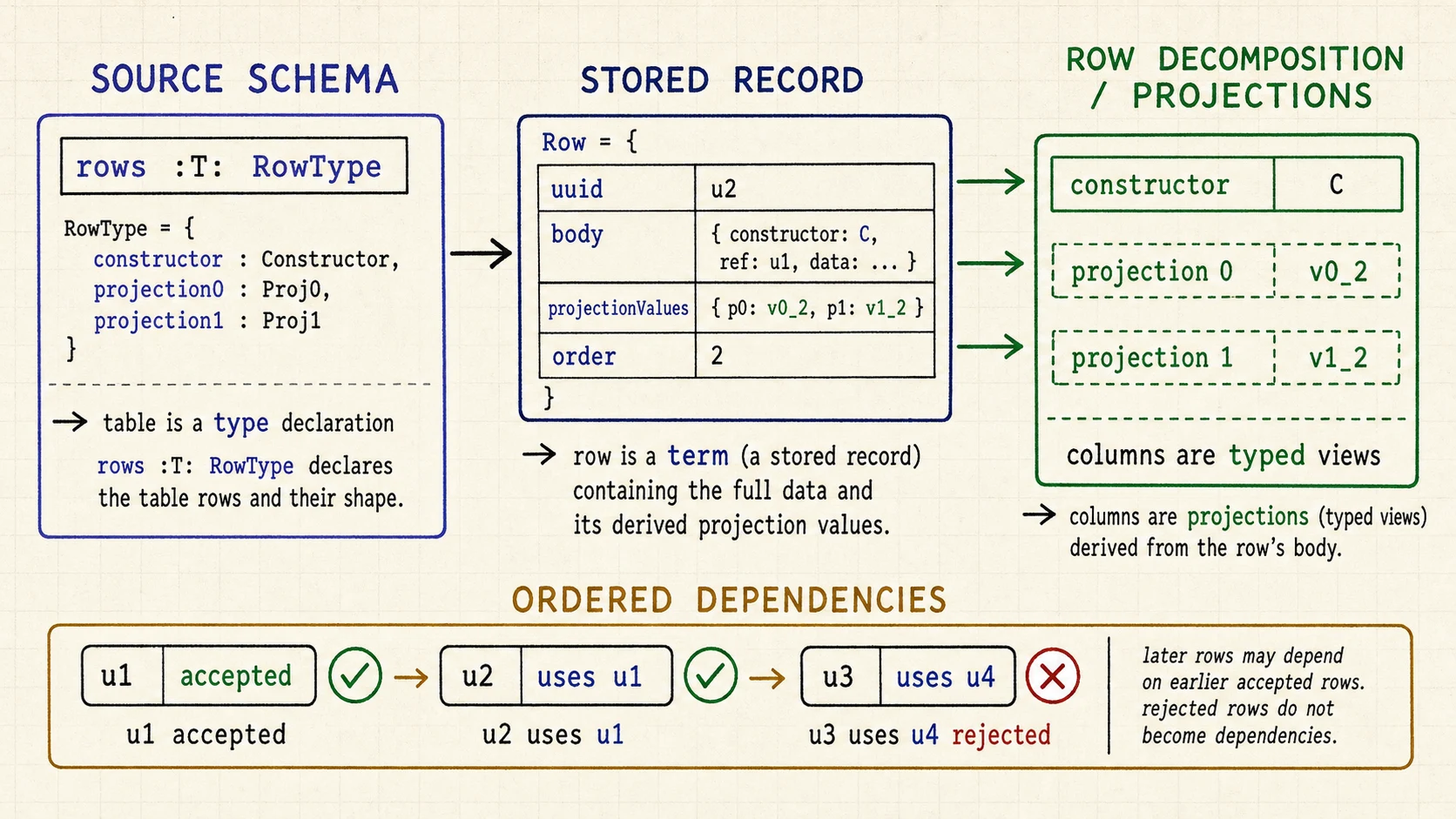
Dependencies made explicit and reliable
Structured views for applications and humans
Accepted or rejected by proof assistants
APIs for discover, edit, verify, consume
Warehouses, APIs, models, rules, reports, and more.
Claims, transformations, policies, proofs, programs, and agent outputs.
Managed term records Durable, ordered, and ready for validation.
Proof assistants decide what is correct.
Trusted, auditable, and ready to use.
Why now
AI systems, editors, and domain tools can now produce many formal candidates. The hard part is not just generating terms; it is giving those terms identity, order, editing, validation, and a route into real applications.
Proof-assistant data was edited and reviewed as files.
Rows, proofs, programs, and domain objects need checker feedback.
Identity, order, UI, APIs, and validation have to stay connected.
The database stores text; the checker decides meaning.
Paradigm
MLTTDB is intentionally small: source files declare tables, the store persists ordered row terms, and proof assistants validate those terms against the declared row types.
entries :T: RowType
{ uuid, body, projectionValues, order }
A source-language type declared in Agda, Lean, or Rocq.
An opaque source-language expression stored with a UUID.
Typed column values derived from the row decomposition contract.
Operational workflow
Applications can call MLTTDB directly: discover tables, insert or edit records, ask for verification, and consume records with a checker-backed status.
Read qualified names, row types, and row decompositions.
Persist records through the WebApp or Admin API.
Separate checker rejection from protocol errors.
Use accepted rows in application flows and reports.
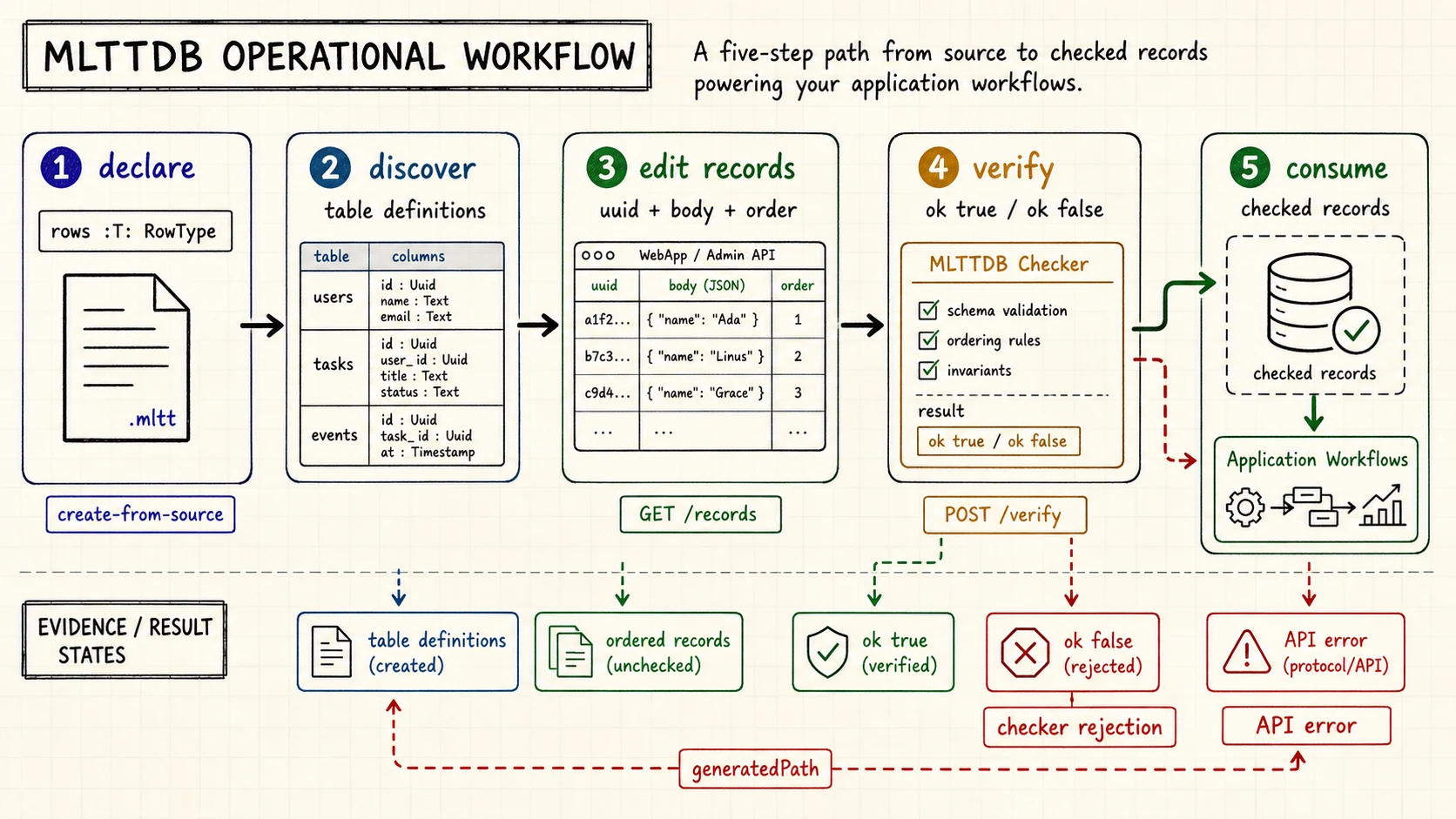
POST /admin-api/v1/databases/demo/create-from-sourcePOST /admin-api/v1/databases/demo/tables/.../recordsPOST /admin-api/v1/databases/demo/verifyChecker paths
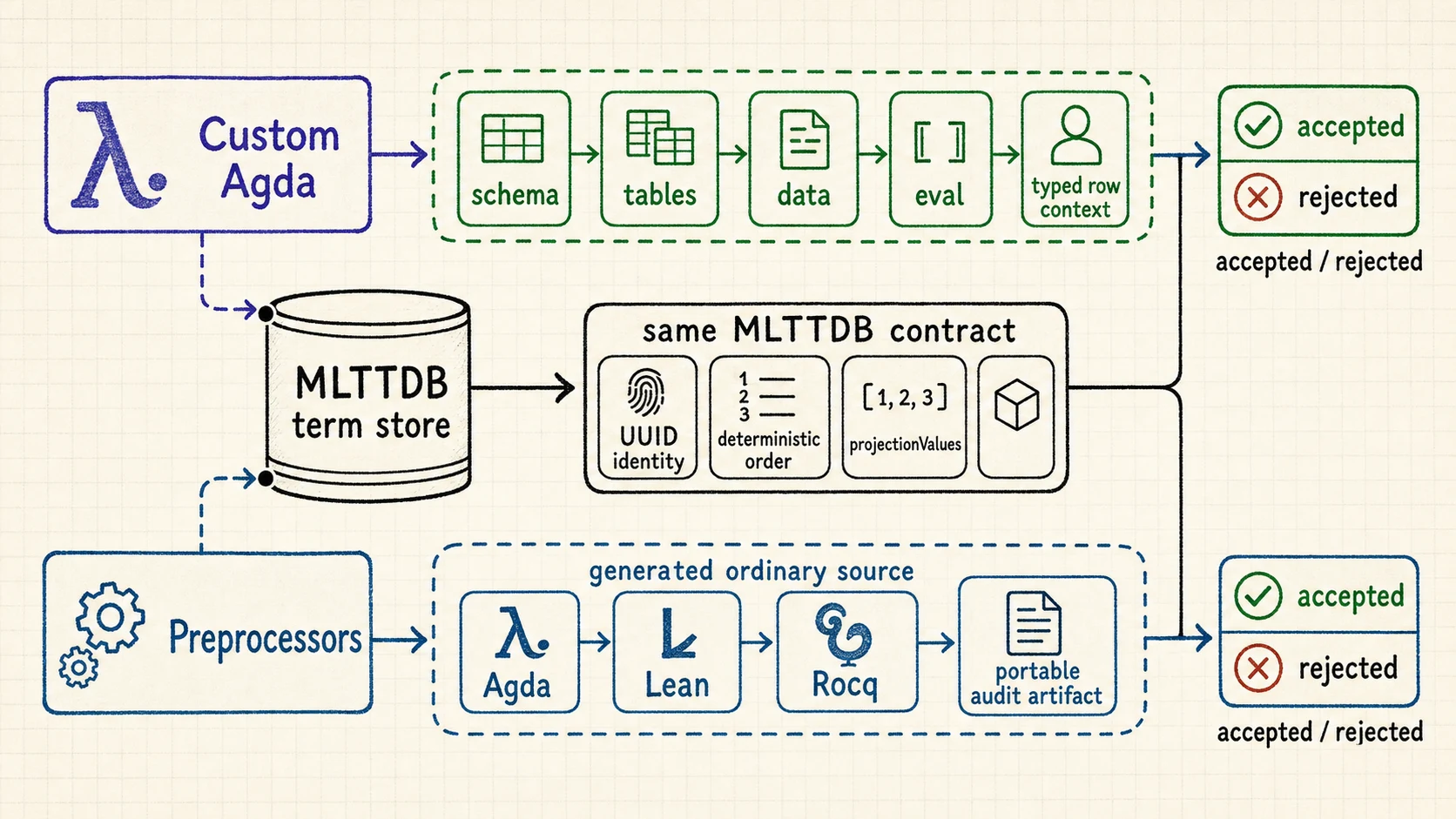
Custom Agda gives direct row-context operations. Preprocessors give portable ordinary source artifacts for existing checker pipelines.
Agda reads MLTTDB tables directly, fetches records, and can evaluate expressions in the checked context before a selected row.
UUID identity, deterministic order, language metadata, projection values, and checker result boundaries stay consistent across both paths.
The preprocessor path materializes records as checker-facing definitions and lets the unmodified proof assistant accept or reject the generated artifact.
Operational surface
The WebApp and APIs expose databases, table definitions, UUIDs, record bodies, projection values, structured editors, row evaluation, and verification triggers.
GET /term-store/v1/databases/{db}/recordsWorking artifact
Implemented scope
HTTP store, WebApp, database metadata, table definitions, ordered records, discovery, verification, row evaluation, and editor configuration.
Agda, Lean, and Rocq preprocessors emit ordinary checker-facing source for schema, table discovery, and data validation.
Agda supports direct --tdb-mode schema|tables|data|eval operation for MLTTDB source files.
Bundled evidence, not a live badge
The copied report records passing checks for the SQLite store, preprocessor paths, and custom Agda MLTTDB path.